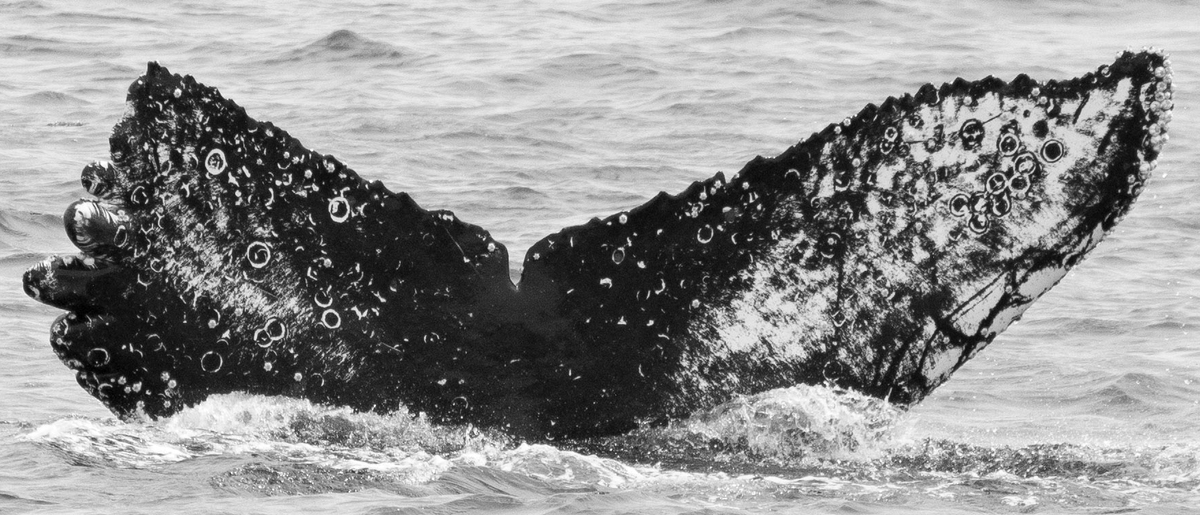
Fingers (California) @7529
"Fingers" aka CRC-12223 was first seen to the best of our knowledge in the breeding season of 2006 in Vallarta, Mexico. Since then Fingers has been regularly seen in Monterey Bay and off the Farallones Islands as recently as this August. Fingers lost half of his or her left fluke at some point between 2014 and 2017, and suffered a major propeller wound to the left flank. Fortunately, the wound to the flank did not penetrate muscle. A major study in the Gulf of Maine (Hill et al., 2017) showed that for wounds that resightings were very rare for whales with deeper wounds, strongly implying that once a ship strike wound cuts into muscle, the whale is extremely likely to die. How can we keep our whales safe? As the British Columbia based Marine Education and Research Society says, "See a blow, go slow!" Travel slowly and be alert when in waters with whales. Bulk shipping represents a large threat to whales, The biggest threat to whales But the real issue comes from large vessels; thanks to efforts of California marine conservation organizations, there is growing momentum to instigate speed limits through the whale rich waters at the mouth of San Francisco Bay. What we know of Fingers is thanks to collaborative research conducted by Cascadia Research Collective, and in Mexico, ECOBAC from the photo-identification catalog of humpback whale of Banderas Bay, Mexico (FIBB catalog).
Monterey Bay · North Pacific
85 Following 58 FollowersSightings by year
2006 – 2026Season Trends
DeepEffort across the feeding and breeding grounds, year over year.
Unlock with Risa DeepTrophy case
3 earnedPods
85 followingLefty (California) @934 since Jul 12, 2026
CRC-15807 @1430 since Jul 12, 2026
CRC-18896 @28218 since Jul 12, 2026
2021 calf of Momster (California) @69535 since Jul 12, 2026
Ratchet (California) @7272 since Jul 11, 2026